Kohl’s planning process forces leadership to evaluate the financial and operational consequences of strategic choices before those choices are embedded in goals, budgets, staffing plans, pricing decisions, marketing programs, lending priorities, or departmental objectives.
Turn profitability facts into strategy, alignment, and daily operating discipline.
Kohl’s Strategic Management Framework connects profitability analytics, operational analytics, driver-based planning, business architecture based alignment, and strategy execution into one closed-loop management system for banks and credit unions.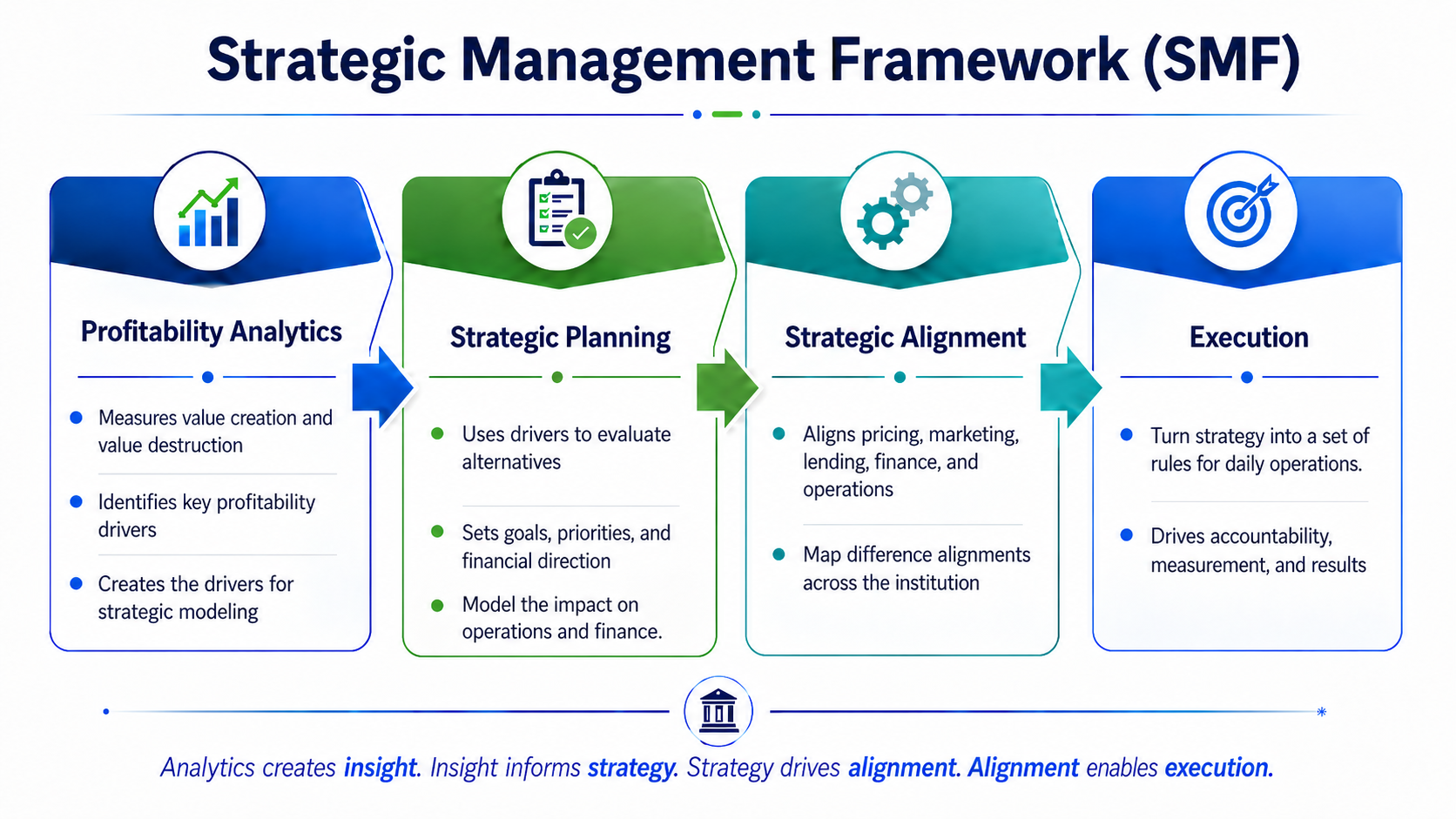
1. Profitability and Operational Analytics: Establishing the Fact Base
The first stage is the primary barrier to entry because it requires more than financial reporting, peer comparisons, executive interviews, or high-level benchmarking.
Kohl starts with an institution’s economics and operations, analyzing profitability across products, customers, officers, branches, channels, and other key areas. This detailed view reveals performance differences that enterprise-level results often hide.
Profitability analytics show the financial outcome, while operational analytics explain the drivers behind it. Kohl’s operational analytics help management identify process costs, complexity, capacity constraints, service model issues, and opportunities for automation, process improvements, staffing adjustments, and policy changes that impact profitability.
Benchmarks provide context but not explanations. While peer comparisons can highlight unusual performance, they do not reveal the customers, relationships, products, or processes driving results. Kohl combines benchmarks with institution-specific profitability and operational analytics to identify the underlying causes and opportunities for improvement.
Kohl helps organizations build strategic plans using the actual drivers of profitability and operations—such as product and relationship profitability, cost-to-serve, pricing, volume, capacity, staffing, market performance, and capital requirements—rather than relying solely on broad growth or expense assumptions.
2. Strategic Planning: Turning Analytics into Driver-Based Strategic Modeling
Strategic planning should not simply describe what leadership wants to accomplish. It should test whether the institution has the economic, operational, financial, and organizational capacity to accomplish it.
From “what do we want?” to “what happens if we do it?”
Institution-specific planning drivers
Planning inputs can include profitability drivers, activity-cost drivers, cost-to-serve assumptions, capacity requirements, staffing impacts, product-level economics, pricing thresholds, market opportunities, branch performance, delivery-channel costs, and capital or RAROA requirements.External and internal environment
External opportunities are evaluated through the lens of internal capability and economic impact. Market conditions, competition, demographics, technology, regulation, operations, capacity, cost structure, and execution capability are treated as connected planning variables.
Value growth versus volume growth
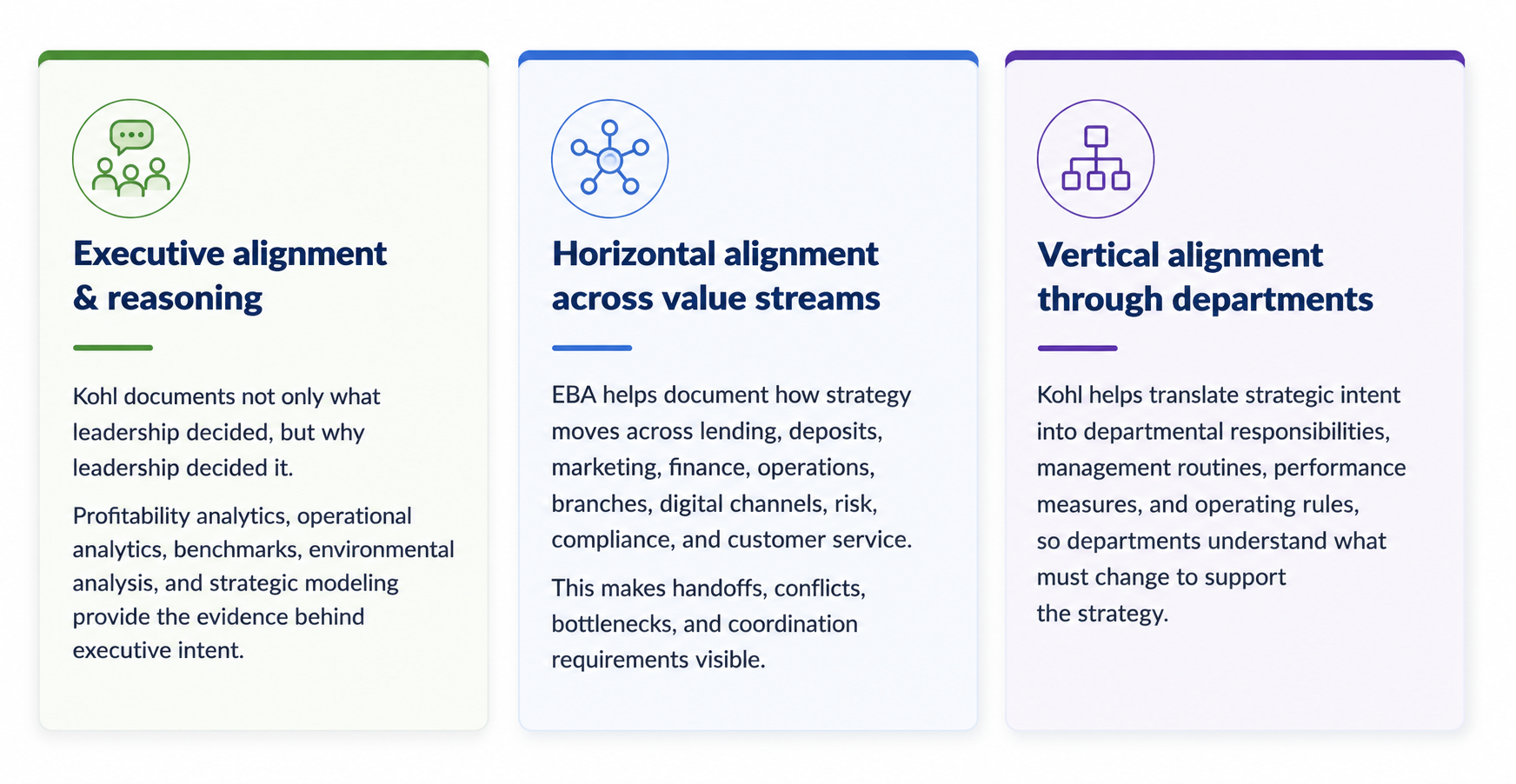
Kohl helps leadership distinguish between growth that increases value and growth that simply increases size. That distinction is essential when managing capital, ROA, RAROA, margin pressure, staffing constraints, and long-term sustainability.3. Strategic alignment: documenting executive, horizontal, and vertical alignment
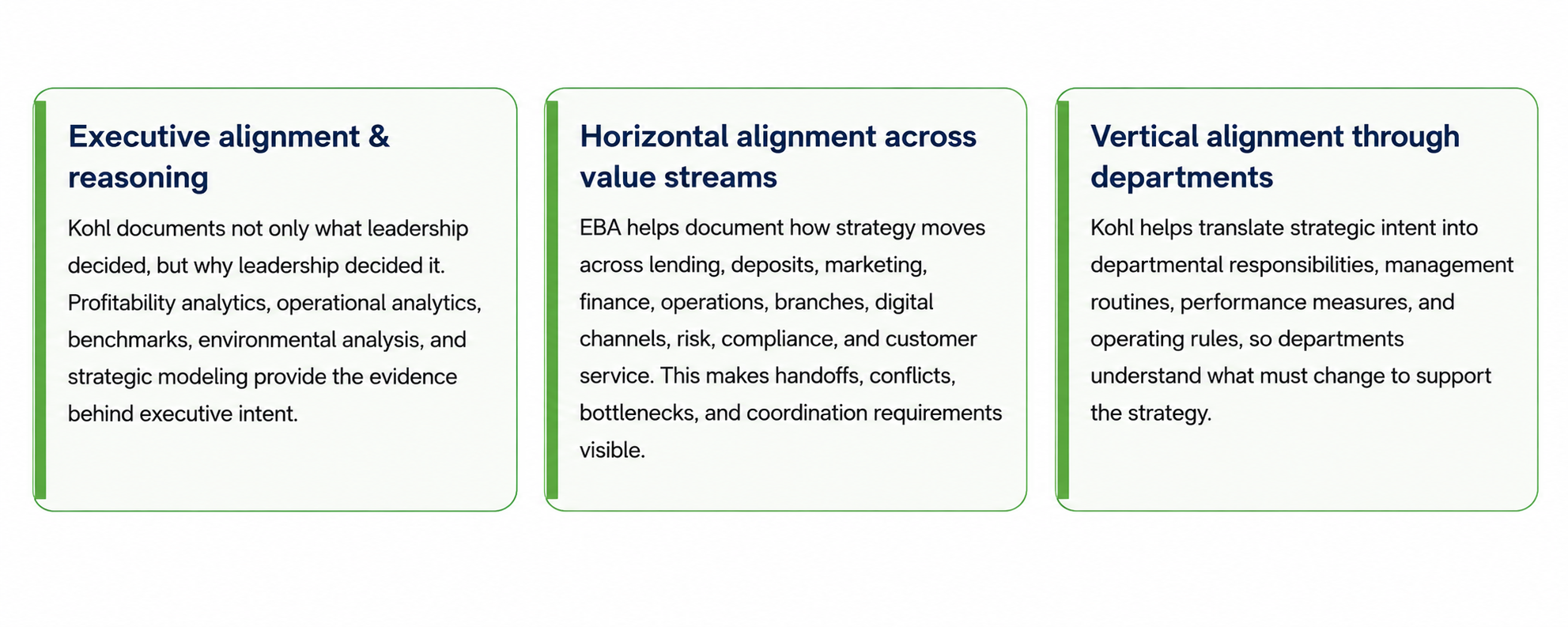
Kohl treats alignment as a management artifact, not a meeting outcome. The goal is to document reasoning, map alignment, and create traceability between strategic intent and operational behavior.
4. Strategy execution: converting strategy into daily operating discipline
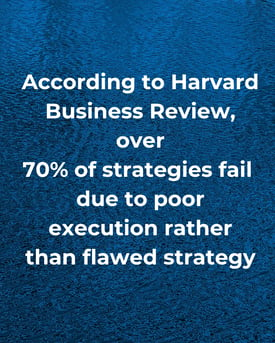
Strategy only creates value when it changes daily behavior. Kohl’s framework turns strategic intent into operating rules, monitoring systems, accountability routines, and adjustment mechanisms.
Consulting Deliverables
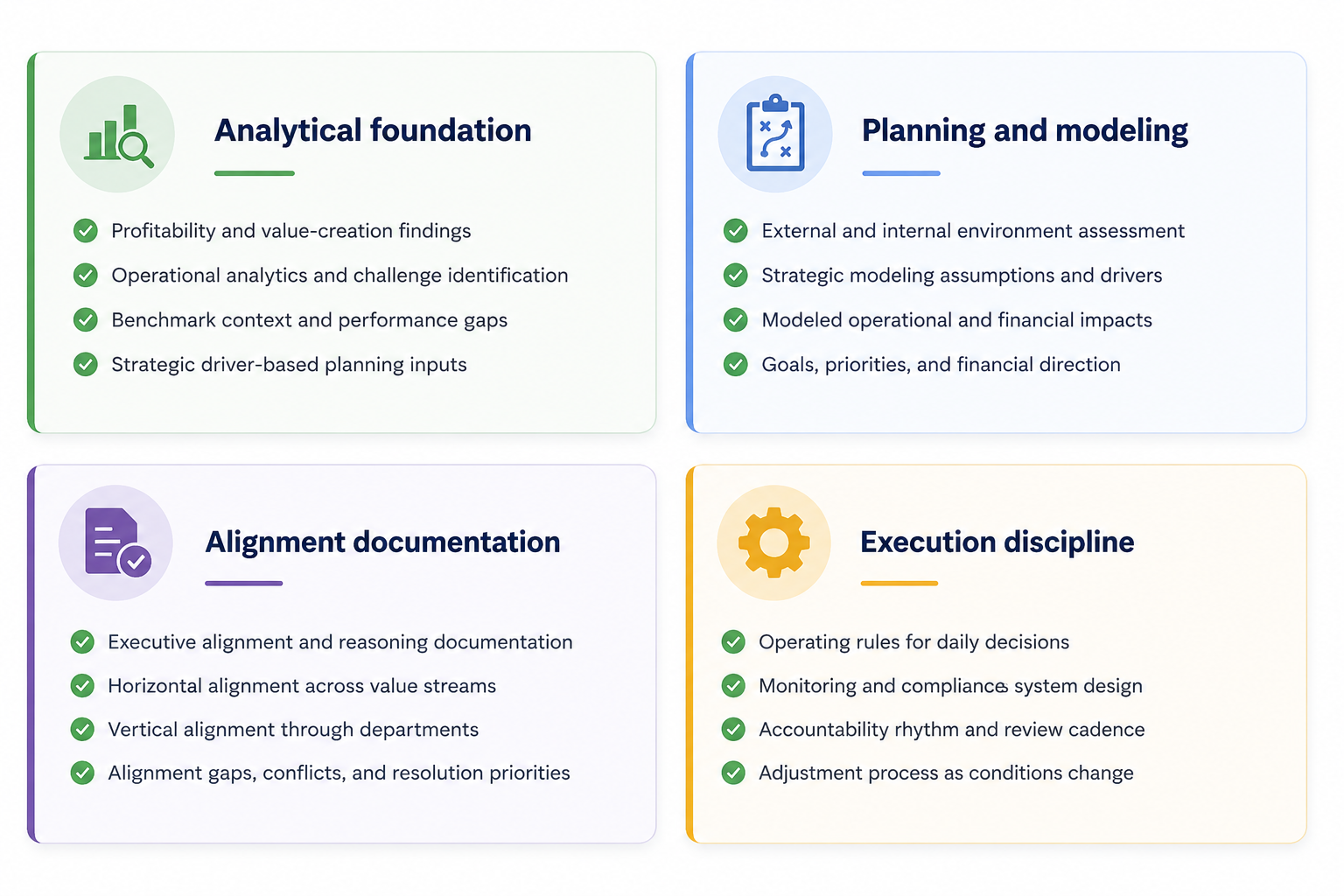
The specific deliverables can be scaled to the institution’s needs, but the engagement is designed to produce concrete management artifacts rather than only recommendations.
.